
Full Service Family Photography Benefits: A 2026 Guide
Table of Contents
What Full Service Family Photography Actually Includes
The Full-Service Workflow, Step by Step
Session Planning and Pre-Session Consultation
The Studio Day: What Happens From Arrival to Last Frame
A Luxury Family Portrait Experience Without the Stress
Hair, Makeup, and a Client Closet That Removes the Guesswork
How the Studio Handles Fussy Newborns and Recovering Mothers
Professional Styling for Family Photos
Full Service vs Digital Only Photography: What You Actually Get
Why Digital Negatives Alone Often Go Unused
Heirloom Artwork and the ROI of Physical Prints
Cost-Benefit Analysis for Families Considering the Investment
The Cumulative Cost of 'Cheap' Sessions
Why Physical Prints Outlast Digital Files
Three Questions to Ask Before You Book
Frequently Asked Questions
Last Updated: September 12, 2026
What Full Service Family Photography Actually Includes
Full service family photography is a boutique model where the studio manages every stage of the portrait process, from the first planning call through the delivery and installation of finished artwork. This guide from K-Rae Images breaks down what that model actually delivers, what it costs in time and money, and why families increasingly choose it over a shoot-and-download arrangement.
The difference shows up before anyone touches a camera. A full-service studio handles session planning, styling, the shoot itself, professional editing, and the final print products. You show up. Everything else is already decided, prepared, and waiting.
That matters because the alternative, a one-hour session that ends with a link to a digital gallery, quietly outsources all the hard work back to you.
The Full-Service Workflow, Step by Step
Most articles describe the full-service model in adjectives. The clearer way to understand it is as a sequence of stages, each with a defined owner and a defined deliverable. Here is what the timeline actually looks like from first contact to finished wall art.
Stage 1: Inquiry and discovery call (week 0). You reach out, and the studio schedules a short call to learn the basics: family size, ages, the occasion, and roughly when you want the session. The studio confirms availability and sends a session guide before you commit to anything.
Stage 2: Pre-session consultation (Weeks before the shoot). This is the planning session described below. The studio and family agree on the purpose of the portraits, where the finished images will hang, and the wardrobe direction. Deliverable: a written session plan.
Stage 3: Styling and preparation (1-2 weeks out). Wardrobe is finalized, the client closet is reserved, and hair and makeup timing is set. Deliverable: a confirmed outfit plan and a session-day schedule.
Stage 4: Session day (1-2 hours). Arrival, styling touch-ups, and the shoot itself, paced in blocks. Deliverable: a full set of captured frames.
Stage 5: Editing and proofing (Right Away). Per-image post-production, then a curated gallery presented to the family. Deliverable: a finished proofing gallery.
Stage 6: Ordering appointment (within 1-2 weeks of editing completion). The studio walks the family through print sizes, album layouts, and wall arrangements. Deliverable: a signed order.
Stage 7: Production and installation (3-6 weeks after ordering). Prints are made, frames assembled, and the studio schedules an installation visit. Deliverable: artwork hung, leveled, and spaced on your wall.
Pro Tip Ask any studio to walk you through these seven stages before you book. A studio that can describe its own workflow in this much detail is a studio that has run it many times.
Session Planning and Pre-Session Consultation
Every full-service engagement starts with a pre-session consultation. This is where the studio learns your family dynamics: how many children, their ages, who is shy, who will not sit still, and what you actually want the images to say.
A good consultation covers three things:
The purpose of the session, whether it is a maternity milestone, a newborn arrival, or a yearly family portrait
Where the finished images will live, such as a staircase wall, an entryway, or an album
The wardrobe and styling direction, decided in advance rather than the night before
That third point is where most DIY sessions fall apart. Choosing outfits for five people the week of a shoot is a project, and it usually ends in compromise.
The Studio Day: What Happens From Arrival to Last Frame
Arrival is designed to be uneventful in the best way. Clients walk into a prepared space: lighting set, props staged, refreshments out, and a clear order of events for the next couple of hours.
The session itself moves in blocks. Group portraits first, while everyone is fresh and cooperative. Then individual child portraits. Then the more relaxed, candid frames once the formality has worn off and real expressions surface.
Professional editing follows. Post-production is not a filter applied to everything. It is per-image work: skin tones corrected, stray hairs cleaned up, background distractions removed, and color graded so a gallery of twenty images looks like one coherent story rather than twenty unrelated pictures.
A Luxury Family Portrait Experience Without the Stress
A luxury family portrait experience is defined less by the price tag than by how little the family has to manage. The studio absorbs the logistics, the styling, and the decision fatigue, and the client's only job is to show up and be present.
That sounds like a small thing until you have done it the other way.
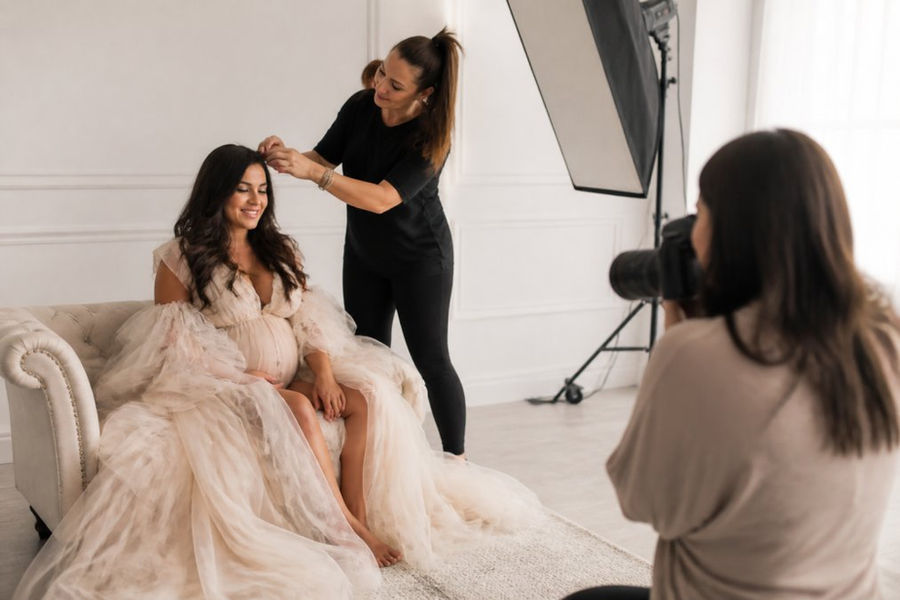
For maternity shoots you will see something like this: A relaxed mother in a flowing couture gown being photographed in a bright boutique studio, with a makeup artist adjusting her hair nearby and soft studio lighting in the background
Hair, Makeup, and a Client Closet That Removes the Guesswork
Professional makeup and access to a stocked client closet eliminate the two most common sources of pre-session anxiety. Instead of buying and returning four dresses, a mother tries on gowns that were chosen specifically because they photograph well.
The client closet matters more than most people expect. Fabrics that look fine in a mirror can go flat, shiny, or shapeless under studio lighting. Gowns selected for photography behave differently, and the difference is visible in the final images.
How the Studio Handles Fussy Newborns and Recovering Mothers
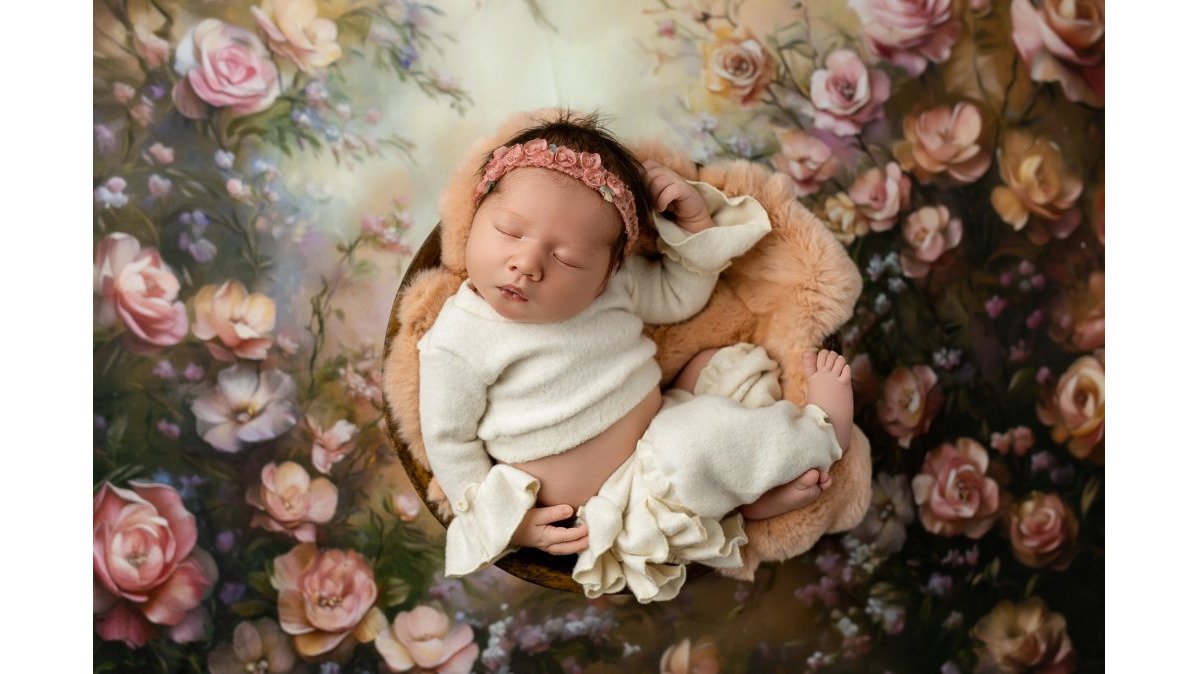
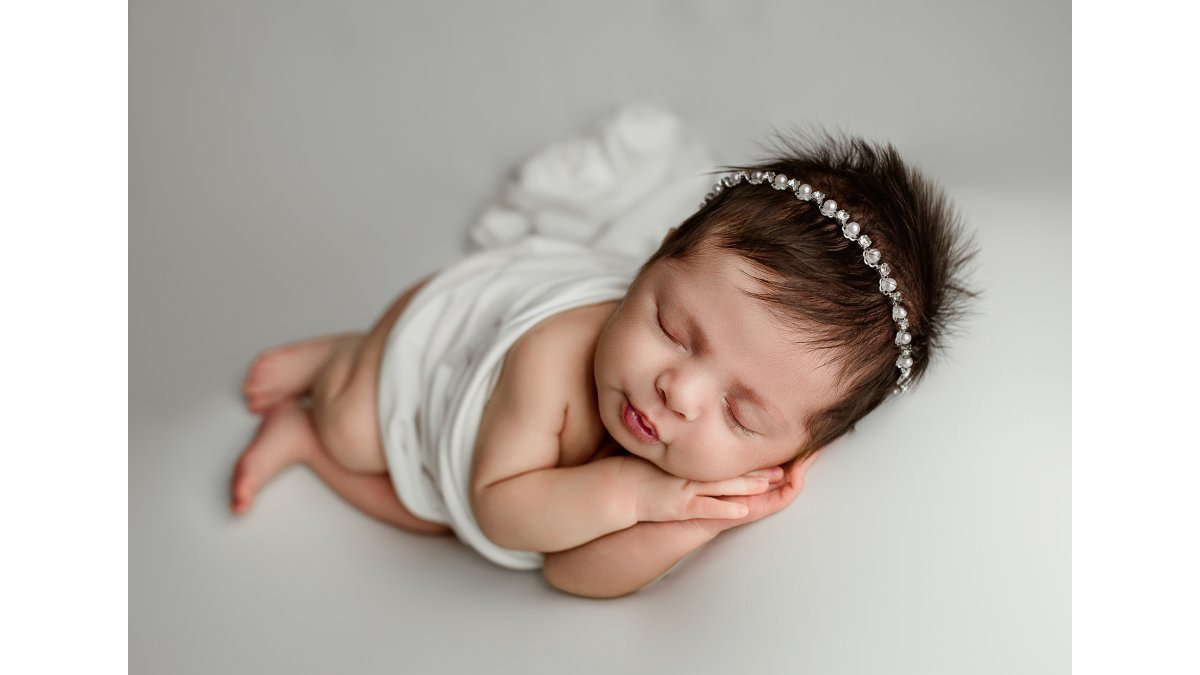
Newborn sessions run on the baby's schedule, not the clock. Experienced newborn photographers build in feeding breaks, warming, and long stretches of patient settling, because a calm baby produces the curled, sleeping poses parents want.
For mothers recovering from a C-section, positioning is adapted rather than forced. Seated and reclined poses, supportive props, and short shooting intervals keep the session comfortable without sacrificing the look of the final portraits. A stocked studio with a dedicated rest area and a zero-gravity massage chair makes the waiting time between setups genuinely restful rather than something to endure.
Professional Styling for Family Photos
Wardrobe styling for family photos is the practice of coordinating every family member's clothing into a single cohesive palette before the session, so no one person visually dominates the frame. It is the difference between a group portrait and five separate portraits standing next to each other.
A common mistake is matching everyone in identical white shirts and jeans. It reads flat on camera and erases personality. Coordinated is not the same as matching.
A workable approach:
Pick two or three colors and vary the shades across family members
Mix textures, such as knit, linen, and denim, to add visual depth
Avoid large logos and busy small patterns, which distract from faces
Dress children last, since their sizes change fastest
Pro Tip Bring one backup outfit per child, not per adult. Children are the ones who spill, and adults rarely need a second option once the palette is set.
Full Service vs Digital Only Photography: What You Actually Get
The core difference between full service vs digital only photography is where the work ends. Digital-only sessions end at a download link. Full-service sessions end with finished, printed artwork on your wall.
Stage | Digital Only | Full Service |
Planning | Client arranges | Studio leads consultation |
Styling | Client handles | Wardrobe and makeup provided |
Session | Fixed time slot | Paced to family needs |
Editing | Basic or none | Full post-production |
Delivery | Digital files | Prints, albums, installation |
Follow-through | Client's responsibility | Studio-managed |
Neither model is dishonest. They simply solve different problems. Digital-only solves "I want pictures." Full service solves "I want pictures on my wall that I will still love in fifteen years."
Why Digital Negatives Alone Often Go Unused
Most families who receive a digital gallery never print from it. The files land in a cloud folder, get shared once, and then sit untouched while the phone fills up with newer snapshots.
This is not a discipline problem. It is a friction problem. Ordering prints means choosing sizes, finding a lab, picking frames, and hanging them straight. That is an evening of work most parents do not have.
Watch Out A digital gallery is not a keepsake. If the drive fails, the account lapses, or the file format ages out, the images are gone. Printed and framed portraits survive all three.
Heirloom Artwork and the ROI of Physical Prints
The return on physical prints is measured in decades, not downloads. Archival prints on acid-free paper, properly framed and displayed away from direct sunlight, hold their color for generations (loc.gov). A hard drive does not make that promise.
That is the honest case for heirloom-quality artwork. It is not that digital files are worthless. It is that they require maintenance to survive, and printed pieces do not.
Wall art installation closes the loop. Instead of handing over a box of frames, the studio hangs the finished pieces, levels them, and adjusts spacing so the arrangement looks intentional from the moment it goes up. The Library of Congress guidance on preserving photographs notes that environmental conditions, especially light and humidity, drive how long printed images last, which is why placement and framing are part of the service rather than an afterthought.
Cost-Benefit Analysis for Families Considering the Investment
A cost-benefit analysis for family portraits should compare total cost, not session fees. The digital-only route looks cheaper at the start, then adds up: the session, the outfits, the prints ordered separately, the frames, and the hours spent coordinating it all.
Full service bundles those costs into one engagement. The trade-off is real: you pay more upfront and you give up some control over how the final products look. For families who want the images to exist as objects rather than files, that trade is usually worth it.
The Cumulative Cost of 'Cheap' Sessions
The hidden expense in the digital-only model is repetition. A family that books a low-cost mini-session every year, receives a download link, and never prints anything ends up with a decade of cloud folders and nothing on the wall. Add up ten years of those sessions and the total is often comparable to a single full-service engagement, but the deliverable is very different: files versus framed artwork.
A useful way to frame the comparison is to ask what you are actually buying. In the digital-only model, you are buying an hour of a photographer's time and a set of files. In the full-service model, you are buying a finished product: portraits chosen, edited, printed, framed, and hung. The second purchase has a longer useful life, which is what makes the upfront number look different when you amortize it across the years the artwork stays on your wall.
Why Physical Prints Outlast Digital Files
The return on physical prints is measured in decades, not downloads. Archival prints on acid-free paper, properly framed and displayed away from direct sunlight, hold their color for generations. A hard drive does not make that promise.
That is the honest case for heirloom-quality artwork. It is not that digital files are worthless. It is that they require maintenance to survive, and printed pieces do not. A cloud account can lapse, a drive can fail, and file formats can age out of common software. A framed print on the wall has none of those dependencies.
Wall art installation closes the loop. Instead of handing over a box of frames, the studio hangs the finished pieces, levels them, and adjusts spacing so the arrangement looks intentional from the moment it goes up. The Library of Congress guidance on preserving photographs notes that environmental conditions, especially light and humidity, drive how long printed images last, which is why placement and framing are part of the service rather than an afterthought.
Watch Out A digital gallery is not a keepsake. If the drive fails, the account lapses, or the file format ages out, the images are gone. Printed and framed portraits survive all three.
Three Questions to Ask Before You Book
Pricing depends on session type, the number of finished pieces, and delivery timelines, so the studio quotes per family rather than publishing a flat rate. Ask for a full quote that includes prints and installation, not just the sitting fee.
What is included beyond the session itself?
How are finished images delivered, and who installs them?
What happens if we are not happy with the final portraits?
Key Takeaway Compare the total cost of getting portraits on your wall, not the cost of the session. That single shift in framing changes which option looks expensive.
Frequently Asked Questions
What does a full-service photography experience include?
A full-service family photography session typically covers pre-session planning, professional hair and makeup, access to a curated wardrobe closet, a guided studio session, professional editing, and a gallery reveal where you choose finished prints and wall art. K-Rae Images handles each of these steps, including refreshments during the session and installation of your final artwork at home, so you are not managing vendors or logistics on your own.
How does full-service photography differ from a standard mini-session?
A mini-session is usually a short time slot with a set number of digital files and minimal styling help. A full-service session includes consultation, wardrobe styling, professional editing, and printed products. The difference shows up in the final result: mini-sessions tend to produce digital files, while full-service sessions produce finished heirloom pieces you can hang on a wall.
Why is professional family photography considered an investment?
Family photography is an investment because the images are meant to last for decades, not just fill a phone gallery. Archival prints and wall art are made with materials designed to resist fading, and the session itself is planned around your family's specific stage. Unlike a one-time digital download, an heirloom piece becomes part of your home and gets passed down.
What are the benefits of having professional hair and makeup for family photos?
Professional hair and makeup remove one of the biggest sources of stress before a session. A stylist works with your features and the studio lighting to make sure you look like yourself, just polished. For maternity and newborn sessions especially, this means you can arrive, sit back, and let someone else handle the details while you focus on your family.
Reach Out Today!

Comments